Showing posts with label Budget 17-18. Show all posts

Sunday, December 3, 2017

First post-GST budget likely on February 1

NEW DELHI: Finance Minister Arun Jaitley is likely to present India's first post-GST and the current government's last full Budget on February 1 next year.

The Budget session of Parliament may begin on January 30 with President Ram Nath Kovind addressing the Joint Session of both the Houses of Parliament, a senior government official said.

The Economic Survey, detailing the state of the economy, is likely to be tabled on January 31 and the Union Budget may be presented the following day, he said.

Scrapping the colonial-era tradition of presenting the Budget at the end of February, Jaitley had for the first time presented the annual accounts on February 1 this year.

The Budget presentation was advanced by a month to ensure that proposals take effect from April 1, the beginning of the new financial year.

Also, the nearly century old tradition of having a separate budget for the railways was scrapped and merged with the general budget.

The tentative schedule being drawn up for the Budget Session means that there would be less than a month's gap between two sessions of Parliament. The Winter Session, which begins on December 15, will end on January 5.

The official said that at least on one occasion in the past -- in 1976, when Indira Gandhi was the Prime Minister, had the winter session spilled into January. But in those days, the Budget was presented on the last day of February and so there was one-month gap between the two sessions.

The Union Budget 2018-19 would be the last full Budget of the BJP-led NDA government before the 2019 General Elections. As per the practice, a vote-on-account or approval for essential government spending for a limited period is taken in the election year and a full-fledged budget presented by the new government.

While P Chidambaram had presented the previous UPA government's vote-on-account in February 2014, Jaitley had presented a full budget in July that year.

The official said this will be the first budget post implementation of the Goods and Services Tax (GST) regime.

Even though independent India's biggest tax reform of GST was implemented from July 1, the Budget for 2017-18 (April- March), had followed the practice of tax revenue projections under the heads of customs duty, central excise and service tax alongside direct tax numbers.


With excise duty and service tax being subsumed in the Goods and Services Tax (GST), the classifications in the forthcoming budget may undergo change, he said.

While a new classification for revenues to be accrued from GST will be included in the Budget for next fiscal, for the current year two sets of accounting may be presented — one for actual accruals during April-June for excise, customs and service tax, and the other for July-March period for GST and customs duty.

The official said that since the GST rates are decided by a GST Council, headed by Union Finance Minister and comprising of representatives of all states, the Budget for 2018-19 may not have any tax proposals concerning excise and service tax levies.

Only proposals for changes in direct taxes, both personal income tax and corporate tax, besides customs duty, are likely to be presented in the Budget along with new schemes and programmes of the government.


Source : TOI

Wednesday, August 30, 2017

No change likely in Financial Year, date of Budget could be advanced further


The government is unlikely to change the financial year to January-December, though it is considering whether it could further advance the date of the presentation of the Budget by a fortnight or so. 

The government this year presented the Budget on February 1, departing from the British-era practice of announcing Budget proposals on February 28. 

India currently follows April-March financial year, again a 150-year-old tradition dating back to British rule. 

The government had been mulling a shift to January-December financial year and set up a committee to deliberate the issue. 

Finance minister Arun Jaitley had on July 21 in a written reply to a question in the Lok Sabha said, "the matter of changing financial year is under consideration of the government". 


"For now (2018-19), changing the financial year appears unlikely," a senior government official told ET, adding that switching this year would mean the budget would have to be presented by end of October or early November, which is unrealistic. 

In addition, there is a is thinking that as a big change in taxation — the GST — has been rolled out, it will take some time to settle down. The GST rollout was preceded by the demonetisation exercise. Change in financial year at this juncture will add to the disruption. 

As elections are scheduled to be held in 2019, experts believe that the government will not change the financial year then as well. 

There have been divergent views on aligning the financial year with the calendar year. 

A committee under former chief economic advisor Shankar Acharya was set up in July, 2016 to look at the feasibility of the idea. The panel, however, did not find much merit in the idea. 

A NITI Aayog discussion note, on the other hand, said a change in the financial year was required as the current system leads to sub-optimal utilisation of working season. The financial year is not aligned with international practices and it impacted data collection and dissemination from the perspective of national accounts. 

A parliamentary panel also recommended shifting the financial year to January-December. 

Prime Minister Narendra Modi, subsequently, at the NITI Aayog governing council meeting on April 23 this year asked the states to "take initiatives in regard of advancing the financial year from January to December", following which Madhya Pradesh announced its intent to change the financial year. 

While a change in the financial year period for now appears unlikely, advancing the date of the budget is a possibility. The government is happy with the outcome of an early budget this year. It enabled front loading of government spending and its capital spending went up by 58 % in the first two months of 2017-18 as compared to the corresponding period of the previous year. 

Source:-The Economic Times

Thursday, February 2, 2017

Highlights of Union Budget 2017

By PTI | Updated: Feb 01, 2017

Finance Minister Arun Jaitley presented the Union Budget 2017, his fourth annual budget, today. Here are the highlights of this year's budget: 

Income Tax rate cut to 5 pc for individuals having income between Rs 2.5 lakh to Rs 5 lakh

10 pc surcharge on individual income above Rs 50 lakh and upto Rs 1 cr to make up for Rs 15,000 cr loss of due to cut in personal I-T rate

15 pc surcharge on income above Rs 1 cr to continue

Of 3.7 cr individuals who filed tax returns in 2015-16, 99 lakh showed income below exemption limit

Direct tax collection not commensurate with income and expenditure pattern

Revenue deficit reduced to 2.1 pc from 2.3 pc for 2016-17

Govt pegs fiscal deficit target at 3.2 per cent for 2017-18 and 3 per cent for next year.

Monetary policy to be expansionary in major economies

More steps will be taken to benefit farmers and the weaker sections; budget being presented during weak global economy

Pace of remonetisation has picked up; demonetisation effects will not spill over to next year

Functional autonomy of the railways to be maintained

Demonetisation will help in transfer of resources from tax evaders to government:

Merger of Railways Budget with General Budget brings focus on a multi-modal approach for development of railways, highways and inland water transport

Only transient impact on economy due to demonetisation; long term benefit include higher GDP growth and tax revenue

GDP will be bigger, cleaner after demonetisation

Effects of demonetisation not expected to spill over to the next year, says Finance Minister
Govt took two tectonic policy initiatives - passage of GST Bill and demonetisation

Demonetisation was a continuation of series of measures taken by govt in 2 yrs; it is bold and decisive measure

We are seen as engine of global growth; IMF sees India to grow fastest in major economies

36 pc increase in FDI flow; forex reserves at USD 361 billion in January enough to cover 12 months needs

CAD declined from 1 pc last year to 0.3 pc in first half of current fiscal: FM
India has emerged as bright spot in the world: FM
Uncertainty around commodity prices especially oil to have impact on emerging economies: FM

Double digit inflation has been controlled; sluggish growth replaced by high growth; war on blackmoney launched: FM

We have moved from discretionary based administration to policy based administration: FM Jaitley

Agricultural sector is expected to grow at 4.1 per cent this fiscal, says Jaitley

Demonetisation was a bold and decisive strike in a series of measures to arrive at a new norm of bigger, cleaner and real GDP

Committed to double farm income in 5 yrs

Plan, non-plan classification of expenditure done away with in the Budget for 2017-18 to give a holistic picture

Mini labs by qualified local entrepreneurs to be set up for soil testing in all 648 krishi vigyan kendras in the country

Budget presentation advanced to help begin implementation of schemes before onset of monsoon

We will continue the process of economic reform for the benfit of poor.
.
Spend more in rural areas, infra, poverty alleviation, while maintaining fiscal prudence as guiding principle of Budget

Our agenda for next year is to transform, energise and clean India

World Bank expects GDP growth rate at 7.6 pc in FY18 and 7.8 pc in FY19

Allocation under MNREGA increased to 48,000 crore from Rs 38,500 crore. This is highest ever allocation

Rs 9,000 cr higher allocation for payment of sugarcane arrears

Target of agriculture credit fixed at Rs 10 lakh cr in 2017-18

Tax administration honouring the honest is one of the 10 pillars of Budget 2017-18

National Testing agency to conduct all examinations in higher education, freeing CBSE and other agencies

133-km road per day constructred under Pradhan Mantri Gram Sadak Yojana as against 73-km in 2011-14

Govt to set up dairy processing fund of Rs 8,000 crore over three years with initial corpus of Rs 2,000 crore

1 cr households to be brought out of poverty under Antodya Scheme

Participation of women in MNREGA increased to 55 pc from 45 pc in past

Modern law on contract farming will be drafted and circulated to states

Dedicated micro-irrigation fund to be created with a corpus of Rs 5000 crore

Market reforms will be undertaken, states will be asked to denotify perishables from Essential Commodities Act

Space technology to be used for monitoring MNREGA implementation

Sanitation coverage in villages has increased from 42 pc in Oct 2016 to 60 pc, a rise of 18 pc, says FM 

We propose to provide safe drinking water to 28,000 arsenic and fluoride affected habitations

To construct one crore houses by 2019 for homeless. PM Awas Yojana allocation raised from Rs 15,000 cr to Rs 23,000 cr

100 pc electrification of villages to be completed by May 2018

27,000 cr on to be spend on PMGSY; 1 cr houses to be completed by 2017-18 for houseless

PM Kaushal Kendras will be extended to 600 districts; 100 international skill centres to be opened to help people get jobs abroad

The allocation for rural agri and allied sector in 2017-18 is record Rs 1,81,223 crore

In higher education, we will undertake reforms in UGC, give autonomy to colleges and institutions

A system of annual learning outcome in schools to be introduced; innovation fund for secondary education to be set up

Two new AIIMS to be set up Jharkhand and Gujarat

New rules regarding medical devices will be devised to reduce their cost

1.5 lakh health sub centres to be converted to Health Wellness Centres 

National Housing Bank will refinance indiviual loans worth Rs 20,000 crore in 2017-18

Rs 500 cr allocated to set up Mahila Shakti Kendras; Allocation raised from Rs 1.56 lakh cr to Rs 1.84 lakh cr for women & child welfare.

Capital and development expenditure pegged at Rs 1.31 lakh cr for railways in 2017-18 from Budget

Allocation for SCs increased from Rs 38,833 cr to Rs 52,393 cr, a rise of 35 per cent

35 pc increase in allocation for SC to Rs 52,393 cr

For senior citizens, Aadhaar based health cards will be issued

Model Shops and Establishment Bill to open up additional opportunities for employment of women

Select airports in tier-II cities to be taken up for operations, development on PPP mode

New metro rail policy to be unveiled

Railway tariffs to be fixed on the basis of cost, social obligation and competition

Service charge on e-tickets booked through IRCTC will be withdrawn

Delhi and Jaipur to have solid waste management plants and five more to be set up later

Government proposes Coach Mitra facility to redress grievances related to rail coaches

500 stations will be differently abled by providing lifts and escalators

Unmanned railway level crossings to be eliminated by 2020

Railway line of 3,500 km will be commissioned in 2017-18 as against 2,800 km in 2016-17

Total allocation for rural, agri and allied sectors for 2017-18 is a record Rs 1,87,223 cr, up 24 per cent from last year

Rs 1 lakh cr corpus for railway safety fund over five years

A scheme for senior citizens to ensure 8 per cent guaranteed returns

Dedicated micro-irrigation fund to be set up by NABARD to achieve mission of Per Drop, More Crop

Digi Gaon will be launched to promote tele-medicine and education

Crude oil strategic reserves to be set up in Odisha and Rajasthan apart from 3 already constructed

Coverage of Fasal Bima Yojana to go up from 30 pc of cropped area to 40 pc in 2017-18 and 50 per cent next year

For transport sector, including railways, road and shipping, government provides Rs 2.41 lakh crore

Allocation of Rs 10,000 cr for Bharat Net project for providing high-speed broadband in FY18

Allocation for national highways stepped up to Rs 64,000 cr from Rs 57,676 cr

Budget allocation for highways stepped up to Rs 64,000 crore in FY18 from Rs 57,676 crore

Dispute resolution in infrastructure projects in PPP mode will be institutionalised

Rs 2,74,114 crore allocated for defence expenditure, excluding pension; This includes Rs 86,000 crore for defence capital

Govt to further liberalise FDI policy

Over 90 per cent of FDI proposls are now processed through automatic route

FIPB will be abolished

Trade Infrastructure Export Scheme to be launched in 2017-18; total allocation for infra at record Rs 3.96 lakh cr

Second phase of solar power development to be taken up with an aim of generating 20,000 MW

After demonetisation on Nov 8 last year, deposit of between Rs 2 lakh and Rs 80 lakh made in 1.09 cr bank accounts at an average of Rs 5.03 lakh till Dec 30

More funds beyond Rs 10,000 cr for recapitalisation of banks will be provided if needed

The shares of railway CPSCs like IRCTC and IRFC to be listed on various stock exchanges

We are largely a tax non-compliant society

New ETF with diverse stocks will be launched in 2017-18

Of 76 lakh individuals who reported income of over Rs 5 lakh, 56 lakh are salaried

Integrated public sector oil major to be created to match global giants

Govt will amend the Multi-state Cooperative Act to protect the poor and gullible investors

Urgent need to protect poor from chit fund schemes, draft bill placed in public domain

Computer emergency response team to be set for cyber security of financial sector

Govt to introduce two new schemes to promote BHIM App - referal bonus for users and cash back for traders

Govt doubles distribution target under Mudra Yojana to Rs 2.44 lakh crore for 2017-18

Over Rs 80 lakh deposits in 1.48 lakh cr at an average of Rs 3.31 cr per account

Customs duty on LNG halved to 2.5 pc

FPI to be exempt from indirect transfer provisions

Political parties can receive donations in cheque, electronic mode; electoral bonds to be issued by RBI

Maximum amount of cash donation a political party can receive will be Rs 2000 from any one source as part of effort to clean political funding

Capital expenditure stepped up by 25.4 pc in FY18 over previous year

Total expenditure in FY18 at Rs 21.47 lakh cr

Duty exempted on various POS machines and iris readers to encourage digital payments

Rs 7,200 cr revenue loss due to reduction in tax on smaller companies

Govt mulling introduction of legal changes to confiscate assets of offenders, including economic offenders, who flee the country

Govt to set up a web-based interactive platform for defence pensioners

Head post offices to issue passports

Govt considering option to amend Negotiable Instruments Act to ensure that holders of dishonoured cheques get payment

FRBM review committee has recommended 60 pc debt to GDP ratio; 0.5 pc of GDP deviation from stipulated fiscal deficit targets

Payment regulatory board to be set up in RBI to regulate electronic payments, replacing Board for Regulation and Supervision in Payments and Settlements System

3 yr period for long-term capital gains tax on immovable property reduced to 2 years; base year indexation shifted from 1.4.1981 to 1.4.2001

A proposal to receive all government receipts beyond a certain threshold through e-modes under consideration

GST implementation to bring more taxes to Centre and states

No transaction above Rs 3 lakh in cash will be allowed as suggested by SIT

Customs duty on LNG to be reduced from 5 pc to 2.5 pc

To make MSME companies more viable, govt proposes to reduce IT tax with annual turn over of Rs 50 core up to 25 per cent

I-T for smaller cos with turnover of upto Rs 50 cr up to 25 per cent

Not possible to remove MAT levied on advance tax for now; carry forward allowed for 15 yrs instead of 10 yrs

Relaxation in norms for Start Ups for getting tax exemption

Capital gains tax exempted for the land pooled to build new capital of Andhra Pradesh effective from 2.6.2014

Increase in personal tax collections is 34.8 per cent in last three quarters. Demonetisation has played a role

17 pc growth in direct tax revenue for the second year in a row in 2016-17

As against 4.2 crore people working in organised sector, only 1.74 crore individuals filed income tax returns

Solar tempered glass used for manufacture of solar cells/panels exempted from customs duty

Import duty on aluminium ores and concentrates raised to 30 pc from nil presently

Actual revenue loss on tax proposals Rs 22,700 cr; gain from additional resource mobilisation is Rs 2,700 cr

Net revenue loss from direct tax proposals to be about Rs 20,000 cr

Excise duty on pan masala containing tobacco (Gutkha) raised to 12 pc from 10 pc

Excise duty on non-filter cigarettes of length not exceeding 65 mm raised to Rs 311 per thousand from Rs 215 per thousand

Source :  http://economictimes.indiatimes.com

Tax rate for lowest income slab slashed to 5% from 10%, surcharge of 10% slapped on incomes over Rs 50 lakh

The finance minister has proposed to slash the tax rate for individuals in the lowest income tax slab – Rs 2.5 lakh to Rs 5 lakh –to 5% instead of 10%. The existing rebate under Section 87A (currently given to people with income up to Rs 5 lakh) is proposed to be reduced to Rs 2500 from the existing Rs 5000 for individuals earning between Rs 2.5 lakh to Rs 3.5 lakh. 

As a result of the combined effect of the new Section 87A rebate and the reduction in the lowest slab tax rate to 5% the tax burden for those with income upto Rs 3 lakh would be zero and tax burden those in the Rs 3 lakh to Rs 3.5 lakh bracket would be Rs 2500. 

Those earning Rs 4.5 lakh can therefore reduce their tax liability to zero by fully utilising the tax break under Section 80C combined with these new proposals. 

Those falling in the higher income tax slabs will also be eligible for this lower tax rate of 5% on income between Rs 2.5 lakh and Rs 5 lakh. Therefore, those in the higher tax slabs will pay lower tax by Rs 12500 per person. 

Individuals earning between Rs 50 lakh and Rs 1 crore will have to pay a surcharge of 10% on the total income tax payable by them. Currently there was no such surcharge on this category. Only those with income above Rs 1 crore were required to pay surcharge of 15% which continues. 

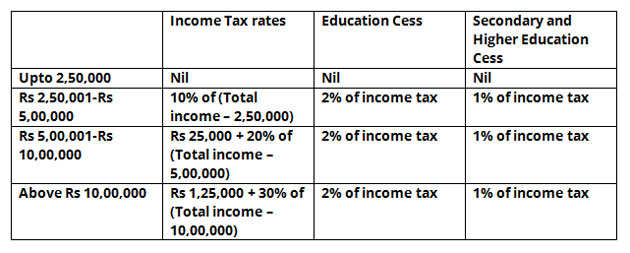
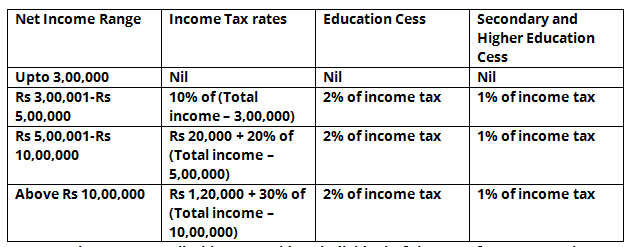
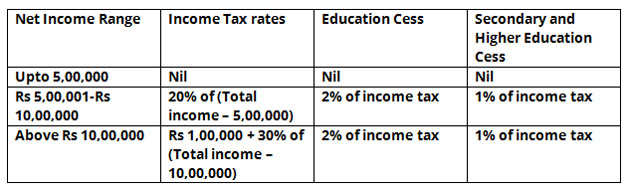
The tax an Indian pays every year is calculated on the basis of his/her gross total income. . The tax is calculated according to the income tax slabs announced by the government every year in the Budget. The annual union budget is normally announced in the month of February. 

Income tax slab rates for the financial year 2016-17 (assessment year 2017-18) are given below in the table: 

1. Normal tax rates applicable to a resident individual below the age of 60 years, non-resident individual, resident/non-resident HUF, AOP, BOI, artificial juridical person. 
Tax rate for lowest income slab slashed to 5% from 10%, surcharge of 10% slapped on incomes over Rs 50 lakh
 2. Normal tax rates applicable to a resident individual of the age of 60 years or above at any time during the year but below the age of 80 years 

 Tax rate for lowest income slab slashed to 5% from 10%, surcharge of 10% slapped on incomes over Rs 50 lakh
3. Normal tax rates applicable to a resident individual of the age of 80 years or above at any time during the year 
 Tax rate for lowest income slab slashed to 5% from 10%, surcharge of 10% slapped on incomes over Rs 50 lakh
 After taking the deductions under Section 80 (C) to 80 (U), the tax is payable after adding the cess and surcharge, if applicable. 

The education cess of 2% and secondary cess of 1% are calculated on the amount of tax payable separately. Both the cess are then added to the tax payable to arrive at the Gross tax payable amount. 

The surcharge is levied @ 15% on the amount of income tax where net income exceeds Rs 1 crore. In the case where the surcharge is levied, the cess will be levied on the tax amount plus surcharge. 

A resident individual can also avail rebate under Section 87(A) whose net income is equal to or less than Rs 5 lakh. The amount of rebate under this section is 100% of the income tax or Rs 5,000 whichever is less. It is deductible before calculating the cess. 

Source:-The Economic Times

Finance Minister reduces the tax rate from 10 to 5 per cent for individual income between Rs 2.5 to Rs 5 lakh.

Press Information Bureau
Government of India
Ministry of Finance

01-February-2017 14:11 IST

Finance Minister reduces the tax rate from 10 to 5 per cent for individual income between Rs 2.5 to Rs 5 lakh.

Finance Minister appeals to all citizens to contribute to Nation Building by making a small payment of 5 per cent tax if their income is falling in this slab.

A simple one- page Income Tax Return form for the category of individuals having taxable income upto Rs 5 lakhs other than business income

The Union Finance Minister Shri Arun Jaitley reduced the rate of taxation from existing 10 per cent to 5 per cent for individual assesses between income of Rs 2.5 lakhs to Rs 5 lakhs. This would reduce the tax liability of all persons below Rs 5 lakh income either to zero (with rebate) or 50 per cent of their existing liability.

While presenting the General Budget 2017-18 in the Parliament today, the Union Finance Minister Shri Jaitley said that the present burden of taxation is mainly on honest tax payers and salaried employees who are showing their income correctly. Therefore, post-demonetisation, there is a legitimate expectation of this class of people to reduce their burden of taxation. The Finance Minister further said that if a nominal rate of taxation is kept for lower slab, many more people will prefer to come within the tax net. The Finance Minister made an appeal to all the citizens of India to contribute to Nation Building by making a small payment of 5 per cent tax if their income is falling in the lowest slab of Rs 2.5 lakhs  to Rs 5 lakhs.

The Union Finance Minister Shri Jaitley said that the Government is trying to bring within tax-net more people who are evading taxes. So, in order to expand tax net, it is decided to have a simple one-page form to be filed as Income Tax Return for the category of individuals having taxable income upto Rs 5 lakhs other than business income. Also, a person of this category who files income tax return for the first time would not be subjected to any scrutiny in the first year unless there is specific information available with the Department regarding his high value transaction.

In his Budget Speech, the Finance Minister further said that in order not to have duplication of benefit, the existing benefit of rebate available to the same group of beneficiaries is being reduced to Rs 2500, available only to assessees upto income of Rs 3.5 lakhs. The combined effect of both these measures will mean that there would be zero tax liability for people getting income upto Rs 3 lakhs per annum. and the tax liability will only be Rs 2,500 for people with income between Rs 3 and Rs 3.5 lakhs. While the taxation liability of people with income upto Rs 5 lakhs is being reduced to half, all the other categories of tax payers in the subsequent slabs will also get a uniform benefit of Rs 12,500 per person. The total amount of tax foregone on account of this measure is Rs 15,500 crore.

In order to make good some of this revenue loss on account of this relief, a surcharge of 10 per cent of tax payable on categories of individuals whose annual taxable income is between Rs 50 lakhs and Rs 1 crore has been proposed. This is likely to give additional revenue of Rs 2,700 crore.

The Finance Minister said that the direct tax proposals for exemptions, etc. would result in revenue loss of Rs 22,700 crore but after counting for revenue gain of Rs 2,700 crore for additional resource mobilisation proposal, the net revenue loss in direct tax would come to Rs 20,000 crore.

Union Budget 2017 : No Cash Transaction above Rs 3 lakh

Press Information Bureau
Government of India
Ministry of Finance
01-February-2017 13:57 IST

Budget gives a major push to Digital Economy; proposes No Cash Transaction above Rs 3 lakh

Government to launch schemes to promote BHIM app, Aadhar Enabled Payment System

Mission to be set-up to achieve a target of 2500 Cr digital transactions in 2017-18

Series of measures proposed to strengthen and regulate digital economy
In a bid to give a push to Digital Economy and weed-out corruption and black money, the Union Minister for Finance and Corporate Affairs, Shri Arun Jaitley in his Budget Speech today said that the Government has decided that no transaction above Rs 3 lakh will be permitted in cash. Accepting a suggestion by Special Investigation Team on Black Money to ban cash transactions above Rs 3 lakhs, the Finance Minister has proposed an amendment to the Income-tax Act in the Finance Bill.

Presenting the General Budget 2017-18 in the Parliament, the Finance Minister said that the Government will launch two new Schemes to promote the usage of BHIM App i.e, Referral Bonus Scheme for individuals and a Cashback Scheme for merchants. BHIM App was launched to promote digital transactions and will unleash the power of mobile phones for digital payments and financial inclusion, The Finance Minister Shri Jaitley informed the House that 125 lakh people have adopted the BHIM app so far.

The Finance Minister Shri Jaitley also announced that Aadhar Pay, a merchant version of Aadhar Enabled Payment System, will be launched shortly. This will be specifically beneficial for those who do not have debit cards, mobile wallets and mobile phones. A Mission will be set-up with a target of 2,500 crore digital transactions for 2017-18 through UPI, USSD, Aadhar Pay, IMPS and debit cards. Banks have targeted to introduce additional 10 lakh new PoS terminals by March 2017. They will be encouraged to introduce 20 lakh Aadhar based PoS by September 2017.

Highlighting the Government’s strategy to clean the system through digital economy, Shri Jaitley said that it has a transformative impact in terms of greater formalisation of the economy and mainstreaming of financial savings into the banking system. This, in turn, is expected to energise private investment in the country through lower cost of credit. India is now on the cusp of a massive digital revolution, he added. The Finance Minister said that a shift to digital payments has huge benefits for the common man. The earlier initiative of the Government to promote financial inclusion and the JAM trinity were important precursors to the current push for digital transactions, the Finance Minister added.

In a bid to incentivize the digital transactions, the Finance Minister Shri Jaitley proposed that the presumptive income tax for small and medium tax payers whose turn-over is up to Rs 2 crore will be reduced from the present 8% of their turnover which is counted as presumptive income to 6% in respect of turnover which is received by non-cash means. This benefit will be applicable for transactions undertaken in the current year also, he added.

The Finance Minister also proposed to limit the cash expenditure allowable as deduction, both for revenue as well as capital expenditure, up to Rs 10,000. Similarly, the limit of cash donation which can be received by a Charitable Trust is being reduced from Rs 10,000/- to Rs 2000/-.

To promote cashless transactions, the Finance Minister in the Budget has proposed to exempt BCD, Excise/CV duty and SAD on miniaturised POS card reader for m-POS, micro ATM standards version 1.5.1, Finger Print Readers/Scanners and Iris Scanners. He also proposed to exempt parts and components for manufacture of such devices, so as to encourage domestic manufacturing of these devices.

To strengthen and regulate the digital economy, the Finance Minister has proposed to create a Payments Regulatory Board in the Reserve Bank of India(RBI) by replacing the existing Board for Regulation and Supervision of Payment and Settlement Systems.  The Committee on Digital Payments constituted by the Department of Economic Affairs has recommended structural reforms in the payment eco system, including amendments to the Payment and Settlement Systems Act, 2007. The Government will undertake a comprehensive review of this Act and bring about appropriate amendments, Finance Minister added.

To strengthen the digital payment infrastructure and grievance handling mechanisms, the Finance Minister said in his Budget Speech  that the focus would be on rural and semi urban areas through Post Offices, Fair Price Shops and Banking Correspondents. He added that steps would be taken to promote and possibly mandate petrol pumps, fertilizer depots, municipalities, Block offices, road transport offices, universities, colleges, hospitals and other institutions to have facilities for digital payments, including BHIM App. A proposal to mandate all the Government receipts through digital means, beyond a prescribed limit, is under consideration. The Government will strengthen the Financial Inclusion Fund to augment resources for taking up these initiatives, the Finance Minister added.

In his Budget Speech, the Finance Minister informed that increased digital transactions will enable small and micro enterprises to access formal credit. He said that the Government will encourage SIDBI to refinance credit institutions which provide unsecured loans, at reasonable interest rates, to borrowers based on their transaction history.

The Finance Minister assured the House that the Government will consider and work with various stakeholders for early implementation of the interim recommendations of the Committee of Chief Ministers on digital transactions.

Shri Jaitley said that the Government is considering the option of amending the Negotiable Instruments Act to ensure that the payees of dishonoured cheques are able to realise the payments.