To view please Click Here.
Showing posts with label GST. Show all posts
Showing posts with label GST. Show all posts
Monday, August 26, 2024
Wednesday, July 26, 2017
Thursday, July 13, 2017
Gifts up to a value of Rs 50,000/- per year by an employer to his employee are outside the ambit of GST
Press Information
Bureau
Government of India
Ministry of Finance
Government of India
Ministry of Finance
10-July-2017 17:09 IST
Gifts up to a value of Rs
50,000/- per year by an employer to his employee are outside the ambit of
GST.
However, gifts of value more
than Rs 50,000/- made without consideration are subject to GST, when made in
the course or furtherance of business.
It is being reported that
gifts and perquisites supplied by companies to their employees will be taxed
under GST. Gifts upto a value of Rs 50,000/- per year by an employer to his
employee are outside the ambit of GST. However, gifts of value more than Rs
50,000/- made without consideration are subject to GST, when made in the course
or furtherance of business.
The question arises as to what constitutes a gift. Gift has not been defined in the GST law. In common parlance, gift is made without consideration, is voluntary in nature and is made occasionally. It cannot be demanded as a matter of right by the employee and the employee cannot move a court of law for obtaining a gift.
Another issue is the taxation of perquisites. It is pertinent to point out here that the services by an employee to the employer in the course of or in relation to his employment is outside the scope of GST (neither supply of goods or supply of services). It follows therefrom that supply by the employer to the employee in terms of contractual agreement entered into between the employer and the employee, will not be subjected to GST. Further, the Input Tax Credit (ITC) Scheme under GST does not allow ITC of membership of a club, health and fitness centre [section 17 (5) (b) (ii)]. It follows, therefore, that if such services are provided free of charge to all the employees by the employer then the same will not be subjected to GST, provided appropriate GST was paid when procured by the employer. The same would hold true for free housing to the employees, when the same is provided in terms of the contract between the employer and employee and is part and parcel of the cost-to-company (C2C).

Thursday, July 6, 2017
Saturday, July 1, 2017
President of India addresses special function in Parliament organized to launch GST
The
President of India, Shri Pranab Mukherjee graced a special function organized
to launch the Goods and Services Tax (GST) in the midnight of June 30- July1,
2017 in the Central Hall of Parliament House, New Delhi.
Speaking
on the occasion, the President said that the introduction of GST is a momentous
event for the nation. It was also a moment of some satisfaction for him
because, as the Finance Minister, he had introduced the Constitution Amendment
Bill on 22nd March 2011. He was closely involved in the design and
implementation and had the occasion to meet the Empowered Committee of state
finance ministers, formally and informally, as many as 16 times. He had also
met the Chief Ministers of Gujarat, Bihar, Andhra Pradesh and Maharashtra a
number of times. He had a vivid recollection of those meetings and the various
matters that were raised. Given the magnitude of the task, which spans
constitutional, legal, economic and administrative spheres, it was not a
surprise that there were many contentious issues. Yet, he found both in those
meetings and in his many interactions with Chief Ministers, Finance Ministers
and officers of States, that most of them had a constructive approach and an
underlying commitment to the introduction of GST. He, therefore, remained
confident that GST was a matter of time and it would eventually be implemented.
His confidence stood justified when, on 8th September 2016, after the Bill was
passed by both Houses of Parliament and more than 50 percent of State
Legislatures, he had the privilege of giving assent to the Constitution (One
Hundred and First Amendment) Act.
The
President said that he was informed that GST would be administered through a
modern world-class information technology (IT) system. He recalled that in July
2010, he had set up an Empowered Group for development of IT systems required
for the GST regime under the chairmanship of Shri Nandan Nilekani. Subsequently
in April 2012, a Special Purpose Vehicle, the GSTN (GST Network), was approved
for creation by the government for GST implementation. This was to ensure that
we lose no time, and as and when the legislative framework is in position, the
technical infrastructure should be ready to take forward GST. A key
feature of the system is that buyers will get credit for tax paid on inputs
only when the seller has actually paid taxes to the government. This creates a
strong incentive for buyers to deal with honest and compliant sellers who pay
their dues promptly.
The
President said that GST is a disruptive change. It is similar to the
introduction of VAT when there was initial resistance. When a change of this
magnitude is undertaken, however positive it may be, there are bound to be some
teething troubles and difficulties in the initial stages. We will have to solve
these with understanding and speed to ensure that it does not impact the growth
momentum of the economy. Success of such major changes always depends on their
effective implementation. In the months to come, based on the experience of
actual implementation, the GST Council and the Central and State Governments
should continuously review the design and make improvements, in the same
constructive spirit as has been displayed till now.
Source:
pib
Cheaper Or Costlier? How GST May Impact Prices Of Goods
GST
or goods and services tax changed the indirect tax landscape of the country
from July 1 by subsuming over a dozen of state and central taxes. Since GST is
meant to eliminate “tax on tax”, experts say overall tax burden on goods is
expected to fall over time. Many essential goods such as unpacked food grains,
gur, milk, eggs and salt won’t attract any tax under GST. Some services will
get costlier as banking and financial services have been put in the 18 per cent
rate slab under GST, from 15 per cent earlier.
“However,
going forward, it is expected that due to reduced cost because of availability
of GST credit on items hitherto not available, the price of services will also
come down which will benefit the consumers,” says Sandeep Sehgal, director-tax
and regulatory at Ashok Maheshwary & Associates LLP.
After
GST rollout, many items like footwear below Rs. 500 and garments could become
cheaper. On the other hand, items like TV and small cars could become costlier.
Petroleum
products such as petrol, diesel and aviation turbine fuel have been kept out of
GST as of now. The GST Council will take a decision on it at a later date.
Alcohol has also been kept out of GST.
Here
is the list of goods, their current effective tax rates and respective GST
rates under the new tax system, according to professional services firm EY:
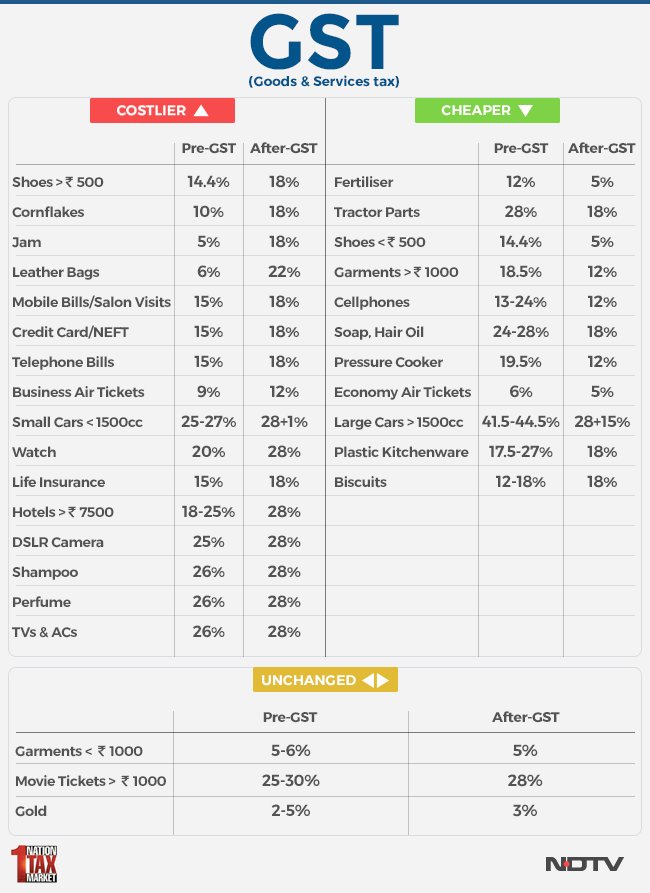
What are the most impacted items due to GST on each items categories
Goods
and Services Tax (GST): At the stroke of midnight on July 1, 2017, 70
years after gaining independence from British colonisers, India will have
another “Tryst with Destiny” as the country will go under a
complete tax overhaul. The new tax regime, the Goods and Services Tax
(GST), will bring massive changes in one of the largest economies of the
world. The GST will change the way people conduct businesses in
India as the country will become a single market with a single tax rate,
irrespective of the state you conduct your business in. Barring a few
exemptions, from the smallest entity on the economic food chain to
multi-billion conglomerates, no one will stay untouched by the GST. The effect
of the new tax regime will be proportional to the size of the entity but
ultimately it will be the end user who will bear the brunt of higher tax rate
or get the benefits of lower taxes.
For
example, most of the services, for which we pay 15 per cent service tax, will
be bracketed into 18 per cent tax slab but some will also get cheaper with 5 per
cent tax slab. Either way, it will take a while to understand how much tax we
are paying on a particular product or service. To make your transition easier,
we have compiled an item-wise list of a plethora of products and their
corresponding tax rates.
Complete
list of GST rates for all the items:
Impact
of GST on Food items
No
tax (0 per cent GST)
Unpacked
foodgrains, fresh vegetables and fruits, unbranded atta, maida, besan, gur,
milk, eggs, curd, lassi, unpacked paneer, unbranded natural honey, palmyra
jaggery, salt, fresh meat, fish, chicken, butter milk, cereal grains hulled

5 per
cent
Sugar, tea, roasted coffee beans, edible oils, cream, skimmed milk powder, milk food for babies, packed paneer, frozen vegetables, cashew nuts, spices, pizza bread, rusk, sabudana, Raisin, fish fillet, packaged food items.

Postponement of provision relating to TDS (Section 51) and TCS ( Section 52) of the CGST / SGST Act 2017
Press
Information Bureau
Government of India
Ministry of Finance
26-June-2017
16:21 IST
Postponement
of provision relating to TDS (Section 51) and TCS ( Section 52) of the CGST /
SGST Act 2017
With the
objective of ensuring smooth rollout of GST and taking into account the
feedback received from the trade and industry regarding the provisions of
deduction of tax at Source under Section 51 of the CGST / SGST Act 2017 and
collection of tax at source under Section 52 of the CGST / SGST Act 2017, the
following has been decided :-
1. The
provisions of Tax Deduction at Source (Section 51 of the CGST / SGST Act 2017)
and Tax Collection at Source (Section 52 of the CGST/SGST Act, 2017) will be
brought into force from a date which will be communicated later.
2.
Persons who will be liable to deduct or collect tax at source will be required
to take registration, but the liability to deduct or collect tax will arise
from the date the respective sections are brought in force.
3. The
persons who were liable to be registered under clause (ix) of Section 24 of the
CGST / SGST Act, 2017 (as they were supplying goods or services through
electronic commerce operator who is required to collect tax at source under
Section 52) will not be liable to register till the provision of Tax Collection
at Source is brought under force. In other words, persons supplying goods or
services through electronic commerce operator liable to collect tax at source
would not be required to obtain registration immediately, unless they are so
liable under Section 22 or any other category specified under Section 24 of the
CGST / SGST Act, 2017 .
This
step has been taken to provide more time for persons liable to deduct tax at
source / E-Commerce Companies and their suppliers to prepare for the historic
tax reform.

Subscribe to:
Posts (Atom)


